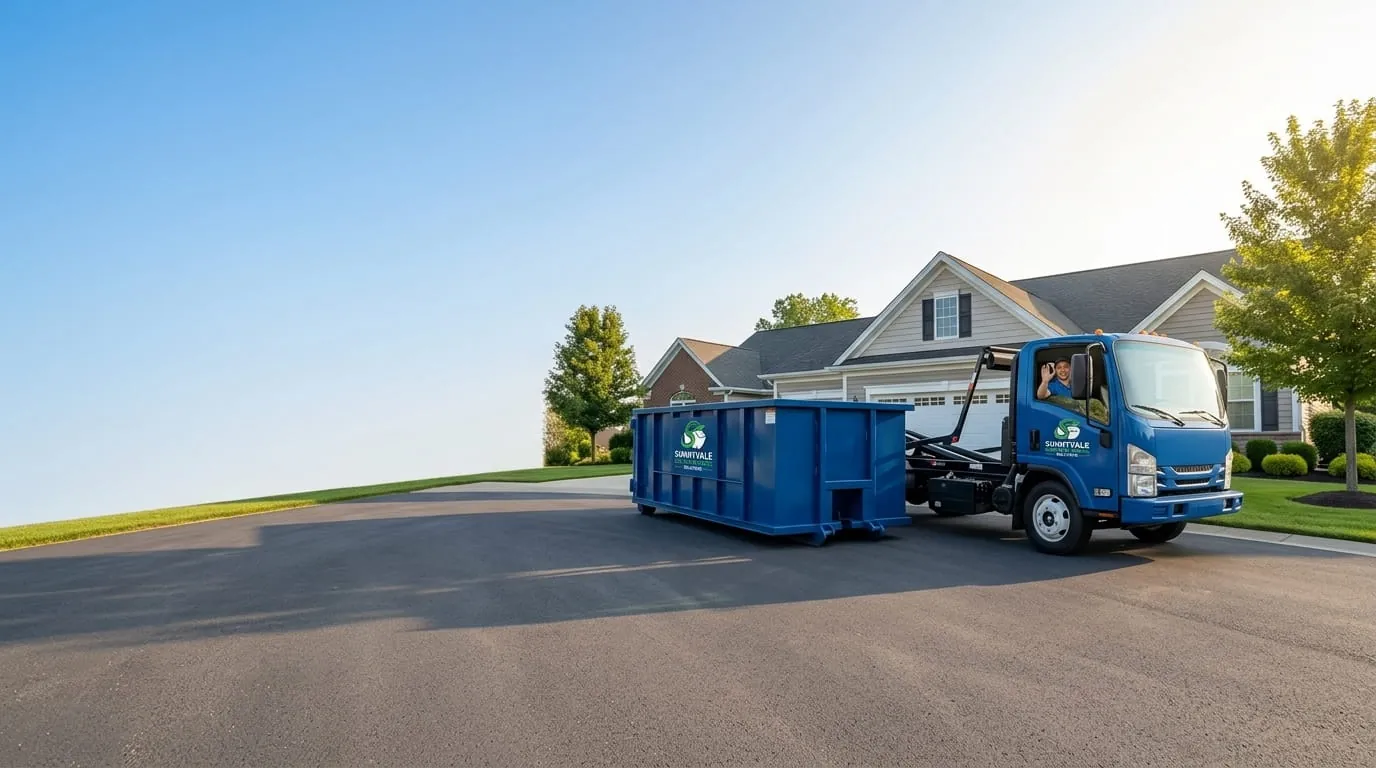
If you're tearing off an old roof anywhere in Sunnyvale or Santa Clara County, the single biggest mistake we see homeowners and contractors make is choosing a dumpster by volume when they should be choosing by weight. Roofing debris is one of the heaviest materials we haul, and a bin that looks half-empty can already be over its weight limit. This guide walks through how to pick the right roofing dumpster in Sunnyvale, CA so your tear-off goes smoothly and you never get surprised by an overage fee.
Why Shingle Debris Is Deceptively Heavy
Asphalt shingles feel light when you're holding a single tab. Stack a couple thousand square feet of them, soaked with California morning dew and layered with old felt, nails, and flashing, and the numbers add up fast. Roofers measure roof area in "squares" — one square equals 100 square feet of roof surface.
A single square of standard three-tab asphalt shingle typically weighs somewhere in the range of 200 to 250 pounds. Architectural (dimensional) shingles run heavier. Now multiply that across an average Sunnyvale single-story home with 20 to 25 squares of roof, and you're looking at thousands of pounds of debris before you even count the underlayment, old nails, drip edge, and any rotted decking that comes off with it.
A dumpster that's only a third full of shingles can already exceed its included weight allowance. With roofing, the fill line you watch is the scale, not the walls of the bin.
The second hidden factor is layers. Many older Sunnyvale homes have had a second roof installed directly over the first — sometimes even a third. Every additional layer doubles or triples the tonnage coming off. Before you rent anything, get up on the roof (or ask your roofer) and confirm how many layers you're tearing off. That one number changes your dumpster choice more than almost anything else.
Sizing by Squares and Layers
Here's the counterintuitive part: for roofing, a smaller bin that stays under its weight limit almost always beats an oversized one. Larger dumpsters tempt you to keep piling debris in, but the included tonnage doesn't grow at the same rate as the volume. You end up paying overage on weight while half the box sits empty.
For most residential asphalt tear-offs in Sunnyvale, a 10-yard dumpster or 15-yard dumpster is the sweet spot. These lower-profile bins have a lower load height, which makes tossing shingles off a roof or a ladder far easier, and their weight allowances are matched to how dense roofing debris is. Bigger 20- and 30-yard boxes are built for bulky, lighter materials like construction framing or household junk — not concentrated weight.
Quick Sizing Reference
Use the table below as a starting point. Always confirm the exact weight allowance when you book, and factor in extra tonnage for multiple layers or heavier architectural shingles.
| Roof Size (Single Layer, Asphalt) | Approx. Squares | Suggested Bin |
|---|---|---|
| Small roof / garage / shed | Up to 15 squares | 10-yard dumpster |
| Average single-story home | 15 - 25 squares | 15-yard dumpster |
| Larger or two-story home | 25 - 35 squares | 15-yard (or two loads) |
| Two or three layers being removed | Any size | Size down + plan a second haul |
| Tile or heavy architectural | Any size | 10-yard, tight weight watch |
Notice the last two rows: when weight is the constraint, you go smaller, not bigger. It's often cheaper and safer to run two properly-loaded 10- or 15-yard bins than to overload a single large one and eat overage charges. If you're still unsure, our guide to choosing a dumpster size breaks the math down further.
Not sure how your roof pencils out? Call us at (669) 332-3989 and we'll size it with you over the phone in a couple of minutes.
Placing the Bin Close to the Work
Roofing is one job where dumpster placement saves real labor. Every shingle you carry an extra 20 feet is time and back strain multiplied by thousands of pieces. Ideally the bin sits directly beside the section of roof you're tearing off, so debris can be slid or tossed straight down into it.
Protect Your Driveway with Boards
Before the dumpster is dropped, lay down plywood or 2x boards where the wheels and any spill zone will land. This protects your Sunnyvale driveway concrete or pavers from scratching and from the stray roofing nails that inevitably scatter during a tear-off. A sheet of plywood leaned against the side of the bin also acts as a backboard, so shingles thrown from the roof funnel in instead of bouncing onto the lawn.
A few placement tips specific to our area:
- Check for low power lines and mature trees — common on older Sunnyvale streets — before choosing the drop spot.
- Keep the bin off the public street if you can; Santa Clara County and city right-of-way placements can require a permit.
- Leave the delivery truck a clear, roughly 60-foot straight approach so the driver can set the bin exactly where you want it.
Tile Roofs: A California Weight Consideration
Clay and concrete tile roofs are common across California, and they are in a weight class of their own. A single square of concrete tile can weigh three to four times what asphalt shingle weighs, and clay isn't far behind. If you're tearing off tile, throw the asphalt sizing rules out the window.
For tile, we almost always recommend the smallest practical bin — a 10-yard dumpster — and a careful eye on tonnage. It is entirely possible to hit a weight limit with a 10-yard bin that's only a quarter full of tile. Broken tile also has sharp, heavy edges, so lower load walls make disposal safer. When in doubt with tile, plan for multiple lighter loads rather than one overweight one, and tell us it's tile up front so we bring the right equipment.
Working With Your Roofer
If you've hired a roofing contractor, coordinate the dumpster before day one. Good roofers move fast — a crew can strip an average Sunnyvale roof in a morning — and the last thing you want is a full crew standing around waiting for a bin. A few questions to settle in advance:
- How many squares and how many existing layers are coming off? This drives the size.
- Does the crew want the bin on the driveway, the street, or the side yard?
- Who's responsible for the rental — you or the contractor? Get it in writing.
- When should the full bin be hauled and, if needed, a second one dropped?
Many Sunnyvale roofers already work with us directly. Our roofing dumpster rental service is set up around tear-off timelines, with prompt drop-off and swap-out hauls so your crew keeps moving.
Avoiding Overage Fees
Overage fees happen when a load exceeds the weight included in your rental. With roofing, this is the number-one budget surprise — and it's almost entirely preventable. Here's how to stay under:
- Size by weight, not by how much space is left. Stop loading when you approach the tonnage limit, even if the bin looks like it has room.
- Keep debris clean. Don't mix in soil, concrete, or a soaked tarp — all of it adds tonnage without adding value.
- Tear off dry when possible. Wet shingles hold significant extra water weight. A dry-day tear-off in our Sunnyvale climate can meaningfully cut the load.
- Split the job into two hauls for large or multi-layer roofs instead of forcing everything into one overweight bin.
- Ask us up front what weight allowance your bin includes and what tonnage your specific roof is likely to produce.
Transparency is the whole point — when you know the weight limit before the first shingle drops, there are no surprises on the final invoice.
Get the Right Roofing Dumpster in Sunnyvale
The right roofing dumpster isn't the biggest one — it's the one sized to your roof's weight, placed close to the work, and matched to your tear-off schedule. Whether you're a homeowner tackling a single garage roof or a contractor stripping a two-story home, getting the size right the first time keeps your project on budget and on time.
Have questions about your specific roof? Reach out through our contact page or call (669) 332-3989. We'll help you choose the right bin, schedule delivery around your crew, and keep you clear of overage fees from the first shingle to the last nail.
Founder, Sunnyvale Dumpster Rental Solutions — sharing straight advice from more than 15 years of local hauling experience.